Overview
Thymalin is a synthetic dipeptide composed of L-glutamic acid and L-tryptophan (L-Glu-L-Trp). Its origin traces to research on thymic tissue extracts conducted at the Saint Petersburg Institute of Bioregulation and Gerontology in Russia, where investigators isolated and characterized bioregulatory peptides from thymic tissue beginning in the 1970s. The dipeptide sequence was subsequently synthesized for laboratory research use, enabling controlled in vitro studies without the variability associated with tissue-derived extracts.
As a two-residue peptide with molecular weight 275.26 g/mol, Thymalin occupies an unusual position in the research peptide literature: structurally among the simplest compounds used in peptide immunoregulation research, yet with a published research base spanning several decades. The research group associated with its characterization — Khavinson and colleagues at the Saint Petersburg Institute — has produced a sustained body of published work on synthetic thymic bioregulatory peptides, of which Thymalin is one of the more studied members.
Biochemical Characteristics
Thymalin's two-residue sequence — L-glutamic acid followed by L-tryptophan — is notable for the combination of a charged polar residue (Glu, with a free carboxylate side chain at physiological pH) and a large aromatic residue (Trp, the bulkiest standard amino acid side chain). This pairing has been examined in published structure-activity relationship work on thymic dipeptides, where researchers have compared the activity profiles of Glu-Trp against other dipeptide combinations derived from thymic extract fractionation studies.
Molecular formula C10H17N3O6, molecular weight 275.26 g/mol, CAS 20816-12-0. As a free dipeptide, Thymalin is highly water-soluble and does not require organic co-solvents for preparation of aqueous assay solutions, which simplifies its handling in cell-based research protocols.
Research Applications
- T-lymphocyte differentiation studies: examining surface marker expression (CD3, CD4, CD8) in primary lymphocyte cultures following Thymalin treatment
- Cytokine expression profiling: measuring interleukin secretion (IL-2, IL-6, IFN-γ) in stimulated immune cell culture systems
- Thymic epithelial cell function assays: examining gene expression and signaling responses in thymic stromal cell models
- Structure-activity relationship studies: comparative assays between Thymalin (Glu-Trp) and other synthetic thymic dipeptides to characterize sequence-specific effects
- Bioregulatory peptide class research: parallel studies alongside other Khavinson-series compounds (e.g., Epitalon, Selank-class peptides) in immune regulation models
- Thymic extract benchmark assays: comparing synthetic Thymalin activity profiles against polypeptide thymic fractions in standardized cell-based assay systems
All applications are restricted to non-clinical laboratory research environments.
Pathway / Mechanistic Context
The mechanistic research on Thymalin has centered on its effects on T-lymphocyte biology. Published work has examined changes in T-cell subset composition and surface marker expression in cell culture systems treated with Thymalin, with particular attention to the CD4/CD8 ratio and markers associated with T-cell maturation stages. The proposed mechanistic basis involves interaction with thymic epithelial cell signaling, which modulates the cytokine milieu that drives T-lymphocyte differentiation in in vitro models.
Interleukin expression studies have measured changes in IL-2 and IL-6 production in Thymalin-treated immune cell cultures, with researchers interpreting these results in the context of the compound's effects on T-helper cell polarization. The Trp residue has been noted in published work as potentially relevant to the compound's interaction with immune cell receptors, given tryptophan's established role in indoleamine signaling pathways, though the mechanistic link in the context of Thymalin specifically remains a subject of ongoing characterization in the published literature.
Preclinical Research Summary
The published research base on Thymalin originates primarily from the Saint Petersburg Institute of Bioregulation and Gerontology, with Khavinson and Morozov as the most frequently cited authors. Khavinson and Morozov (2003, Neuroendocrinology Letters) provided a comprehensive review of the synthetic bioregulatory peptide research program, contextualizing Thymalin within the broader class of thymic dipeptides characterized by this research group and summarizing the published in vitro and animal model evidence for immune-regulatory effects.
Khavinson et al. (2003, Bulletin of Experimental Biology and Medicine) documented specific effects on T-lymphocyte populations and cytokine profiles in published cell-based assay work. Anisimov et al. (2005, Annals of the New York Academy of Sciences) provided independent context for the bioregulatory peptide class in a broader review of synthetic peptide research, offering a perspective from outside the originating institution on the published evidence base for thymic dipeptides including Thymalin.
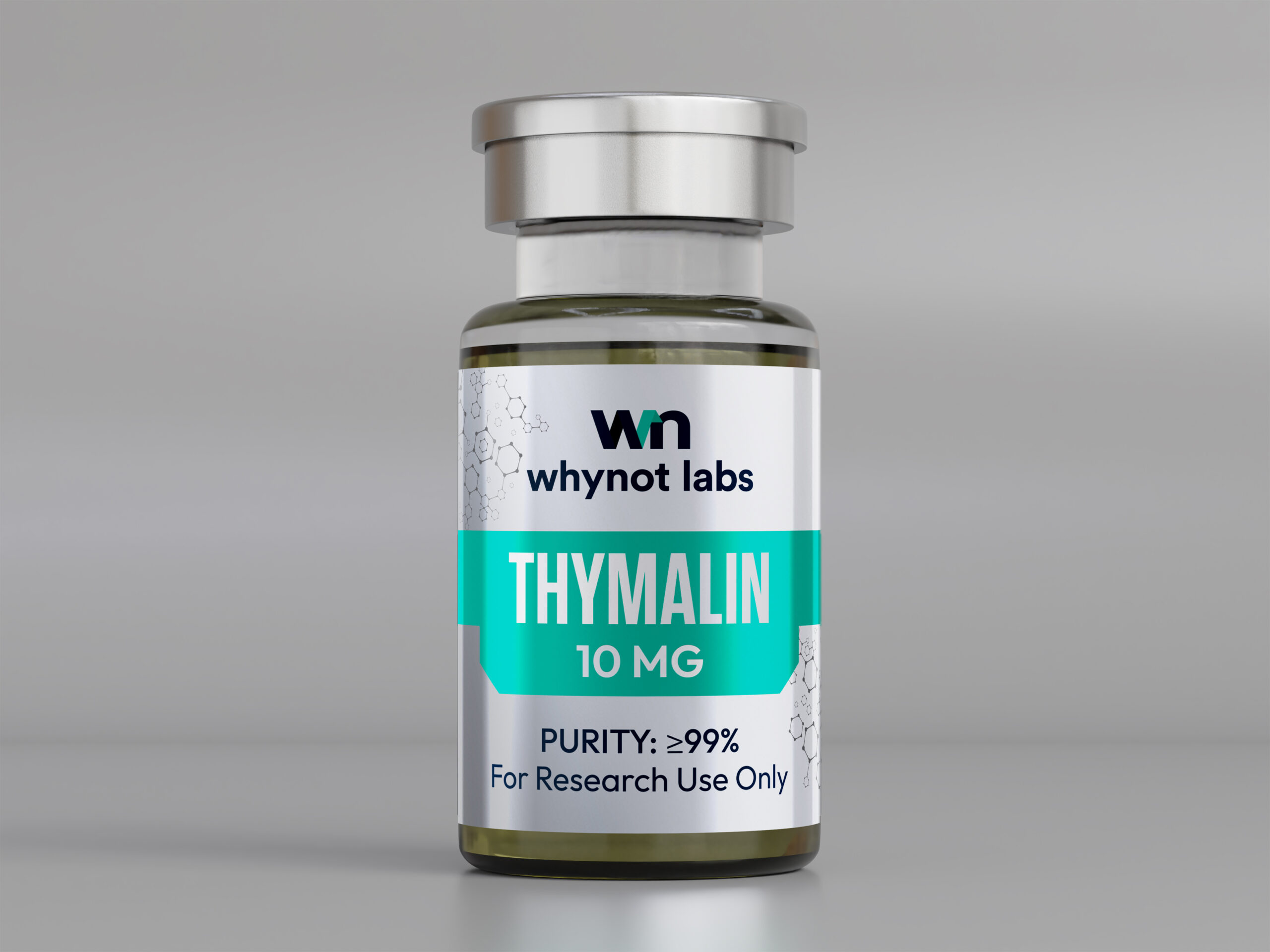
Thymalin 10mg is supplied as research-grade lyophilized powder. The small dipeptide structure (MW 275.26 g/mol) makes this one of the more straightforward compounds in our catalog for reconstitution and assay preparation. Each batch is submitted to Vanguard Laboratory for conformity testing using a 5-vial protocol. The 7-panel protocol covers identity verification (mass spectrometry), purity analysis (≥98% via HPLC), net content verification (10mg confirmed), endotoxin levels, heavy metals screening, sterility, and overall conformity assessment. Batch-specific COAs are published on our COA Library and linked via QR code on each vial.
Referenced Citations
- Khavinson VK et al., “Tetrapeptide EPKG and dipeptide GW stimulate lymphocyte differentiation,” Bull Exp Biol Med, 2003 135(2):149–151.
- Khavinson VK & Morozov VG, “Peptides of pineal gland and thymus prolong human life,” Neuro Endocrinol Lett, 2003 24(3–4):233–240.
- Anisimov VN et al., “Inhibitory effect of the peptide epithalon on the development of spontaneous mammary tumors in HER-2/neu transgenic mice,” Ann N Y Acad Sci, 2005 1057:521–535.
ALL ARTICLES AND PRODUCT INFORMATION PROVIDED ON THIS WEBSITE ARE FOR INFORMATIONAL AND EDUCATIONAL PURPOSES ONLY.
RUO Disclaimer
The products offered on this website are furnished for in-vitro studies only. In-vitro studies (Latin: in glass) are performed outside of the body. These products are not medicines or drugs and have not been approved by the FDA to prevent, treat or cure any medical condition, ailment or disease. Bodily introduction of any kind into humans or animals is strictly forbidden by law. This product should only be handled by licensed, qualified professionals.
This product is not a drug, food, or cosmetic and may not be misbranded, misused, or mislabeled as a drug, food, or cosmetic. No statements on this website have been evaluated by the FDA. You must be 21 years or older to purchase.