

Free delivery for orders over $150

Chemical Properties
| Peptide Class | 39-residue synthetic dual GIP/GLP-1 receptor agonist |
| C-Terminal Modification | C20 fatty diacid moiety via linker |
| Molecular Formula | C225H348N48O68 |
| Molecular Weight | 4813.45 g/mol |
| Purity | ≥98% (Vanguard Laboratory Verified) |
| Form | Lyophilized Powder |
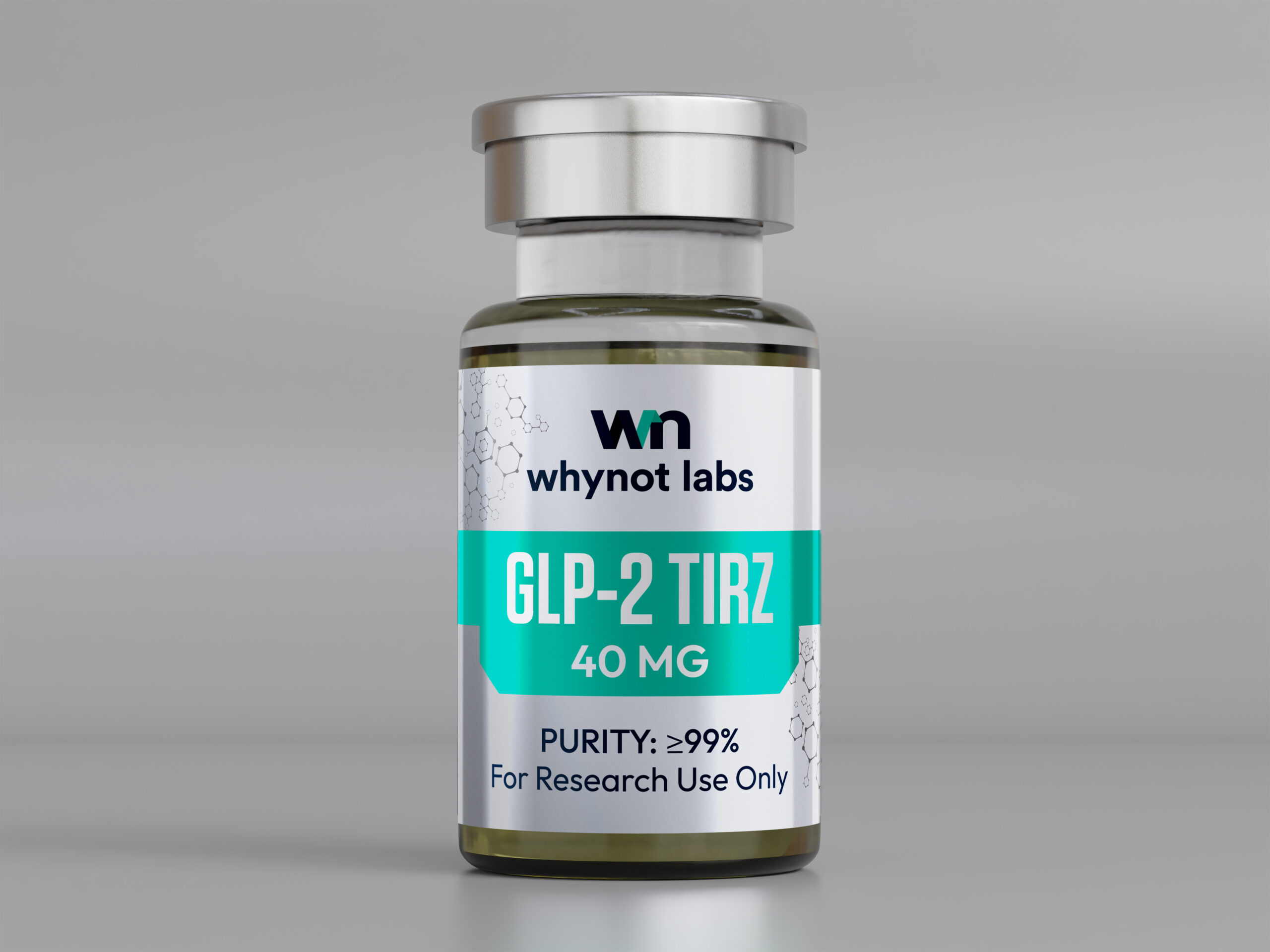
| Net Content | 40mg per vial |
| Amino Acids | 39 residues |
| Storage | -20°C long-term. 2–8°C short-term. Protect from light. |
Identifiers
| CAS Number | 2023788-19-2 |
| PubChem CID | 2762989 |
| Product Name | GLP-2 Tirz |
| Batch ID | WNL-2602-D01 |
| Testing Partner | Vanguard Laboratory (ISO/IEC 17025:2017, A2LA) |
2D Structure — GLP-2 Tirz (verify image renders correctly before publishing — delete tag if fragment)

- 1. Overview
- 2. Biochemical Characteristics
- 3. Research Applications
- 4. Pathway / Mechanistic Context
- 5. Preclinical Research Summary
- 6. Form & Analytical Testing
- 7. Referenced Citations
- 8. RUO Disclaimer
Overview
GLP-2 Tirz is a 39-amino acid synthetic peptide designed as a dual agonist at two incretin receptors: the glucose-dependent insulinotropic polypeptide receptor (GIPR) and the glucagon-like peptide-1 receptor (GLP-1R). First described in published literature, the compound represents a structurally distinct approach to incretin receptor pharmacology research compared to single-agonist GLP-1R compounds. The backbone is derived from the GIP sequence, with modifications introduced to enable simultaneous GIPR and GLP-1R engagement. A C20 fatty diacid moiety, attached via a short linker, provides the lipophilic modification that has been characterized in published research as influencing the compound's activity profile in experimental systems.
What distinguishes GLP-2 Tirz in the published receptor pharmacology literature is its imbalanced agonism: the compound shows stronger functional activity at GIPR than at GLP-1R. This asymmetry — the reverse of the receptor preference seen in some other dual-agonist analogs — has been a focus of published in vitro receptor selectivity studies and forms the basis of comparative pharmacology work between GLP-2 Tirz and single-receptor reference compounds.
Biochemical Characteristics
The 39-residue sequence of GLP-2 Tirz is based on the GIP backbone, modified at multiple positions to introduce GLP-1R activity alongside the native GIPR activity of the parent sequence. Published structural analyses have characterized the key substitution positions that shift the compound from a GIPR-selective agonist to a dual receptor agonist. The C20 fatty diacid modification — attached through a gamma-glutamic acid and mini-PEG linker at a specific lysine residue — is structurally analogous to the lipid conjugation strategy used in GLP-1 Sema, though with a different chain length and attachment site.
Molecular formula C225H348N48O68, molecular weight 4813.45 g/mol, CAS 2023788-19-2, PubChem CID 2762989. The fatty acid modification confers albumin binding in solution, which has been shown in published work to affect the compound's behavior in cell-based assay systems — a factor researchers account for in assay design when studying its receptor interaction kinetics.
Research Applications
- Dual receptor binding characterization: radioligand competition assays at GIPR and GLP-1R in membrane preparations and intact cell systems
- Imbalanced agonism studies: comparative functional assays quantifying relative potency ratios at GIPR vs. GLP-1R using cAMP accumulation as readout
- cAMP signaling assays: HTRF and ELISA-based cAMP measurement in GIPR-expressing and GLP-1R-expressing cell lines following GLP-2 Tirz treatment
- Receptor selectivity comparisons: head-to-head in vitro assays comparing GLP-2 Tirz against single-agonist GLP-1R and GIPR reference compounds
- GIP backbone structure-activity relationship (SAR) studies: examining which sequence modifications are responsible for GLP-1R co-agonism in the context of the GIP scaffold
- Fatty acid conjugation studies: mechanistic work on how C20 diacid modification affects receptor binding kinetics, albumin binding, and assay behavior relative to unlipidated analogs
- Incretin receptor co-agonism pathway research: downstream signaling studies examining GIPR/GLP-1R co-activation using parallel or combined receptor expression systems
All applications are restricted to non-clinical laboratory research environments.
Pathway / Mechanistic Context
Both GIPR and GLP-1R are Gs-coupled GPCRs. Agonist binding at either receptor activates adenylyl cyclase, elevating intracellular cAMP and downstream PKA signaling. GLP-2 Tirz engages both receptors simultaneously in cell-based assay systems, making it a tool for studying the consequences of parallel incretin receptor activation on shared and divergent downstream signaling branches.
The imbalanced agonism profile — stronger GIPR relative to GLP-1R activity — has been characterized in published cAMP accumulation studies using GIPR- and GLP-1R-expressing cell lines. Coskun et al. (2022, Molecular Metabolism) provided detailed in vitro receptor pharmacology data characterizing the potency ratio between the two receptors, establishing that the compound's GIPR activity exceeds its GLP-1R activity by a measurable margin in cell-based assay conditions. This asymmetry is relevant to researchers designing comparative experiments where receptor-specific contributions to downstream signaling need to be deconvoluted.
The C20 fatty diacid modification contributes to albumin binding in solution, which affects the free compound concentration available for receptor engagement in serum-containing assay systems. Published research has characterized this effect, and it is an important assay design consideration when interpreting potency data from cell-based experiments conducted in serum-supplemented media.
Preclinical Research Summary
The published in vitro characterization of GLP-2 Tirz has focused primarily on receptor pharmacology. Coskun et al. (2022, Molecular Metabolism) provided the most detailed published account of the compound's dual-receptor activity profile, including cAMP accumulation data at GIPR and GLP-1R, receptor binding kinetics, and a characterization of the imbalanced agonism that defines the compound's selectivity profile. This study provides the mechanistic framework used in subsequent in vitro research referencing GLP-2 Tirz as a dual-receptor tool compound.
Thomas et al. (2021, Journal of Clinical Endocrinology & Metabolism) provided clinical pharmacology data on the compound's behavior in human subjects, which is included here as a citation context. For in vitro researchers, the more directly relevant published work remains the receptor pharmacology characterization studies, which document the binding kinetics and signaling parameters measured in cell-based assay systems. Min and Bain (2021, Diabetes Therapy) reviewed the incretin receptor co-agonist compound class, providing structural and mechanistic context for understanding GLP-2 Tirz within the broader landscape of GIPR/GLP-1R dual-agonist research compounds.
Form & Analytical Testing
GLP-2 Tirz 40mg is supplied as research-grade lyophilized powder. 40mg is a substantial quantity for in vitro receptor pharmacology work. Each batch is submitted to Vanguard Laboratory for conformity testing using a 5-vial protocol. The 7-panel protocol covers identity verification (mass spectrometry), purity analysis (≥98% via HPLC), net content verification (40mg confirmed), endotoxin levels, heavy metals screening, sterility, and overall conformity assessment. Batch-specific COAs are published on our COA Library and linked via QR code on each vial.
Referenced Citations
- Coskun T et al., “LY3298176, a novel dual GIP and GLP-1 receptor agonist for the treatment of type 2 diabetes mellitus: From discovery to clinical proof of concept,” Mol Metab, 2022 66:101609.
- Min T & Bain SC, “The role of tirzepatide, dual GIP and GLP-1 receptor agonist, in the management of type 2 diabetes,” Diabetes Ther, 2021 12(2):273–291.
- Thomas MK et al., “Dual GIP and GLP-1 receptor agonist tirzepatide improves beta-cell function and insulin sensitivity in type 2 diabetes,” J Clin Endocrinol Metab, 2021 106(2):388–396.
ALL ARTICLES AND PRODUCT INFORMATION PROVIDED ON THIS WEBSITE ARE FOR INFORMATIONAL AND EDUCATIONAL PURPOSES ONLY.
RUO Disclaimer
The products offered on this website are furnished for in-vitro studies only. In-vitro studies (Latin: in glass) are performed outside of the body. These products are not medicines or drugs and have not been approved by the FDA to prevent, treat or cure any medical condition, ailment or disease. Bodily introduction of any kind into humans or animals is strictly forbidden by law. This product should only be handled by licensed, qualified professionals.
This product is not a drug, food, or cosmetic and may not be misbranded, misused, or mislabeled as a drug, food, or cosmetic. No statements on this website have been evaluated by the FDA. You must be 21 years or older to purchase.
Batch COA: In Progress
This batch is currently undergoing conformity testing at Vanguard Laboratory. The full Certificate of Analysis — covering identity, purity (≥98% via HPLC), net content (40mg confirmed), endotoxins, heavy metals, and sterility — will be published here and linked via QR code on each vial upon completion.
We don't ship product before results are in. When the COA is live, you'll find it here and on our COA Library.
Related Products
In stock
Bulk Pricing
| 1 – 4 | Full Price |
| 5 – 9 | 10% OFF |
| 10+ | 15% OFF |
In stock
Bulk Pricing
| 1 – 4 | Full Price |
| 5 – 9 | 10% OFF |
| 10+ | 15% OFF |
In stock
Bulk Pricing
| 1 – 4 | Full Price |
| 5 – 9 | 10% OFF |
| 10+ | 15% OFF |
In stock
Bulk Pricing
| 1 – 4 | Full Price |
| 5 – 9 | 10% OFF |
| 10+ | 15% OFF |
In stock
Bulk Pricing
| 1 – 4 | Full Price |
| 5 – 9 | 10% OFF |
| 10+ | 15% OFF |
In stock
Bulk Pricing
| 1 – 4 | Full Price |
| 5 – 9 | 10% OFF |
| 10+ | 15% OFF |