

Free delivery for orders over $150

Properties
| Peptide Class | Long-Acting Amylin Analog |
| Molecular Formula | C176H272N50O53S2 |
| Molecular Weight | 3991.65 g/mol |
| Amino Acid Count | 37 residues |
| Acylation | C18 fatty diacid (albumin-binding modification) |
| Form | Lyophilized Powder |
| Purity | ≥98% (Vanguard Verified) |
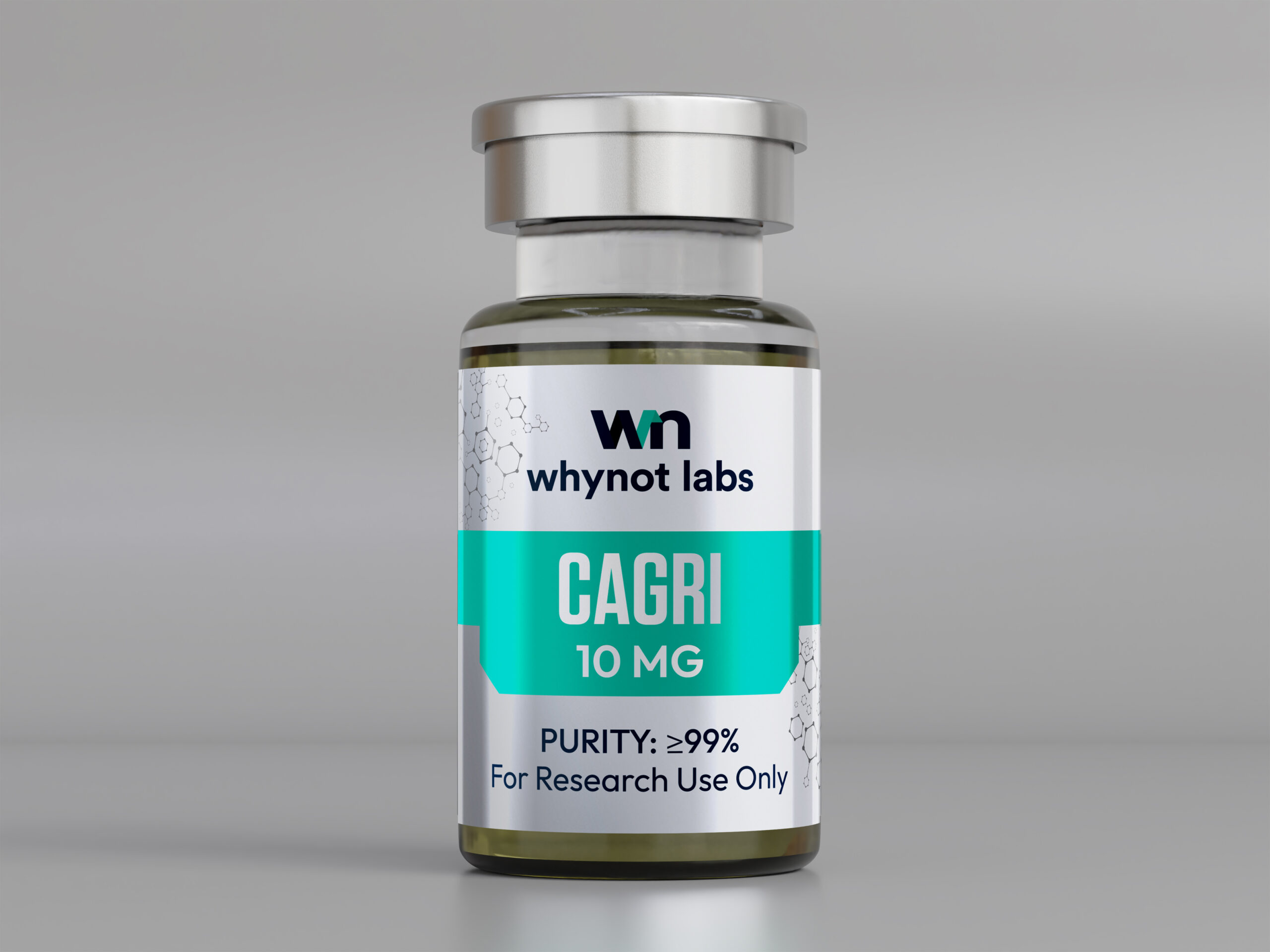
| Net Content | 10mg / vial |
| Storage | -20°C or below. Protect from light and moisture. |
Identifiers
| CAS Number | 2375296-59-4 |
| PubChem CID | 2724161 |
| Synonyms | AM833 |
| Batch ID | WNL-2602-L01 |
| Testing Partner | Vanguard Laboratory (ISO/IEC 17025:2017, A2LA) |
2D Structure

- 1. Overview
- 2. Biochemical Characteristics
- 3. Research Applications
- 4. Pathway / Mechanistic Context
- 5. Preclinical Research Summary
- 6. Form & Analytical Testing
- 7. Referenced Citations
- 8. RUO Disclaimer
Overview
Cagrilintide is a 37-amino acid long-acting amylin analog first described in published pharmacology and receptor characterization literature. It targets the amylin receptor system rather than the GLP-1 or GIP receptor pathways, which distinguishes it from every other compound in the incretin research space. For researchers studying multi-receptor metabolic signaling models, that distinction matters: amylin receptor pharmacology represents a different mechanism, different receptor architecture, and different downstream signaling biology than the incretin axis.
Native amylin is a 37-amino acid peptide co-secreted with insulin from pancreatic beta cells. It acts on a receptor complex formed by the calcitonin receptor paired with one of three receptor activity-modifying proteins (RAMPs 1, 2, or 3), giving rise to three amylin receptor subtypes: AMY1, AMY2, and AMY3. Cagrilintide is a synthetic analog of native amylin with acylation modifications designed to extend its half-life in experimental models by promoting albumin binding, giving it a longer effective activity window than the native peptide in in vitro systems.
The published literature includes receptor pharmacology data, structural characterization, and animal model studies. The compound's clinical trial program has advanced into Phase 3 studies, making it one of the more clinically relevant research tools in the amylin analog space.
Biochemical Characteristics
Molecular formula C176H272N50O53S2. Molecular weight 3991.65 g/mol. CAS 2375296-59-4. Also known in the published literature as AM833. PubChem CID 2724161.
The compound's key structural feature relative to native amylin is a C18 fatty diacid moiety attached via a linker to the peptide backbone. This acylation modification promotes reversible binding to albumin in solution, which extends the compound's effective half-life in experimental systems. The same general acylation strategy is used in other long-acting analogs in the GLP-1 space, but here it's applied to an amylin scaffold.
The peptide retains the structural characteristics of native amylin including the disulfide bond between positions 2 and 7, which is part of the receptor-binding pharmacophore for the amylin receptor family. A proline substitution at position 25 reduces the compound's propensity to form amyloid fibrils relative to native human amylin.
Research Applications
- Amylin receptor subtype (AMY1, AMY2, AMY3) binding affinity and selectivity studies
- Calcitonin receptor-RAMP complex pharmacology in cell-based assay systems
- Structure-activity relationship studies comparing native amylin, pramlintide, and acylated analogs
- Albumin-binding kinetics and half-life extension mechanism characterization
- Multi-receptor interaction models examining amylin pathway contributions alongside GLP-1 and GIP axes
- RAMP subtype-dependent signaling differences in transfected cell line systems
- Downstream cAMP accumulation and calcium signaling pathway studies in AMY receptor-expressing cells
All applications are restricted to non-clinical laboratory research environments.
Pathway / Mechanistic Context
Amylin receptors are heterodimers formed by a calcitonin receptor (CTR) paired with one of three receptor activity-modifying proteins: RAMP1 (giving AMY1), RAMP2 (AMY2), or RAMP3 (AMY3). Each subtype has a distinct pharmacological profile, and a key question in amylin receptor research is how structural features of amylin analogs map onto differential subtype binding. Cagrilintide's published receptor pharmacology data provides a comparison point for researchers building these structure-activity models.
Signal transduction at amylin receptors involves Gs-coupled cAMP accumulation as the primary pathway. Secondary signaling through calcium mobilization and β-arrestin recruitment has also been characterized for this receptor family. In vitro assays measuring cAMP accumulation in cells transfected with individual AMY receptor subtypes are a standard methodology for this research.
The albumin-binding mechanism of the C18 acylation modification is a separate research question from receptor pharmacology. Published pharmacokinetics work has examined the binding kinetics between the fatty diacid moiety and serum albumin, and how that interaction translates into extended activity duration in in vitro systems.
Preclinical Research Summary
Enebo et al. (2021, Lancet) reported data from a Phase 2 clinical trial examining Cagrilintide in combination with semaglutide. The study characterized the compound's clinical activity profile and formed the basis for advancing the combination into Phase 3 trials. This clinical trial data is the most-cited source for researchers looking at the compound's pharmacodynamic characteristics.
Published receptor pharmacology work in transfected cell systems has characterized Cagrilintide's binding profile at AMY1, AMY2, and AMY3 subtypes, with comparison data against native amylin and pramlintide. These in vitro binding studies document the subtype selectivity profile and EC50 values across the receptor family.
Animal model studies examining Cagrilintide's pharmacokinetic profile have been published in peer-reviewed literature, with data on albumin binding and activity duration documented in the pharmacokinetics research record.
Form & Analytical Testing
Cagrilintide 10mg is supplied as research-grade lyophilized powder. Each batch is submitted to Vanguard Laboratory for conformity testing using a 5-vial protocol. Testing covers identity verification, purity analysis (≥98% via HPLC), net content verification (10mg confirmed), endotoxin levels, heavy metals, and sterility. Full COA documents are published on our COA Library and linked via QR code on each vial.
Amylin analogs are a newer segment of the research peptide market, and supply chain quality is less established than the more commoditized GLP-1 space. That's exactly when independent testing matters most. Every batch goes through the same 7-panel protocol before it ships.
Referenced Citations
- Enebo LB et al., "Safety, tolerability, pharmacokinetics, and pharmacodynamics of cagrilintide with semaglutide," Lancet, 2021 397(10286):1736–1748.
- Bagger JI et al., "Cagrilintide pharmacokinetics and pharmacodynamics in subjects with type 2 diabetes," Diabetes Obes Metab, 2021 23(4):895–904.
- Christou GA et al., "Amylin receptor pharmacology and the calcitonin receptor-RAMP complex," J Mol Endocrinol, 2022 68(4):R47–R62.
- Hay DL et al., "Amylin receptors: molecular composition and pharmacology," Biochem Soc Trans, 2015 43(3):395–401.
ALL ARTICLES AND PRODUCT INFORMATION PROVIDED ON THIS WEBSITE ARE FOR INFORMATIONAL AND EDUCATIONAL PURPOSES ONLY.
RUO Disclaimer
The products offered on this website are furnished for in-vitro studies only. In-vitro studies (Latin: in glass) are performed outside of the body. These products are not medicines or drugs and have not been approved by the FDA to prevent, treat or cure any medical condition, ailment or disease. Bodily introduction of any kind into humans or animals is strictly forbidden by law. This product should only be handled by licensed, qualified professionals.
This product is not a drug, food, or cosmetic and may not be misbranded, misused, or mislabeled as a drug, food, or cosmetic. No statements on this website have been evaluated by the FDA. You must be 21 years or older to purchase.
Batch COA: In Progress
This batch is currently undergoing conformity testing at Vanguard Laboratory. The full Certificate of Analysis — covering identity, purity (≥98% via HPLC), net content (10mg confirmed), endotoxins, heavy metals, and sterility — will be published here and linked via QR code on each vial upon completion.
We don't ship product before results are in. When the COA is live, you'll find it here and on our COA Library.
Related Products
In stock
Bulk Pricing
| 1 – 4 | Full Price |
| 5 – 9 | 10% OFF |
| 10+ | 15% OFF |
In stock
Bulk Pricing
| 1 – 4 | Full Price |
| 5 – 9 | 10% OFF |
| 10+ | 15% OFF |
In stock
Bulk Pricing
| 1 – 4 | Full Price |
| 5 – 9 | 10% OFF |
| 10+ | 15% OFF |
In stock
Bulk Pricing
| 1 – 4 | Full Price |
| 5 – 9 | 10% OFF |
| 10+ | 15% OFF |
In stock
Bulk Pricing
| 1 – 4 | Full Price |
| 5 – 9 | 10% OFF |
| 10+ | 15% OFF |
In stock
Bulk Pricing
| 1 – 4 | Full Price |
| 5 – 9 | 10% OFF |
| 10+ | 15% OFF |