FOR RESEARCH PURPOSES ONLY-This compound is not FDA approved. All data presented is from clinical trials for educational reference

SS-31

SKU: N/A

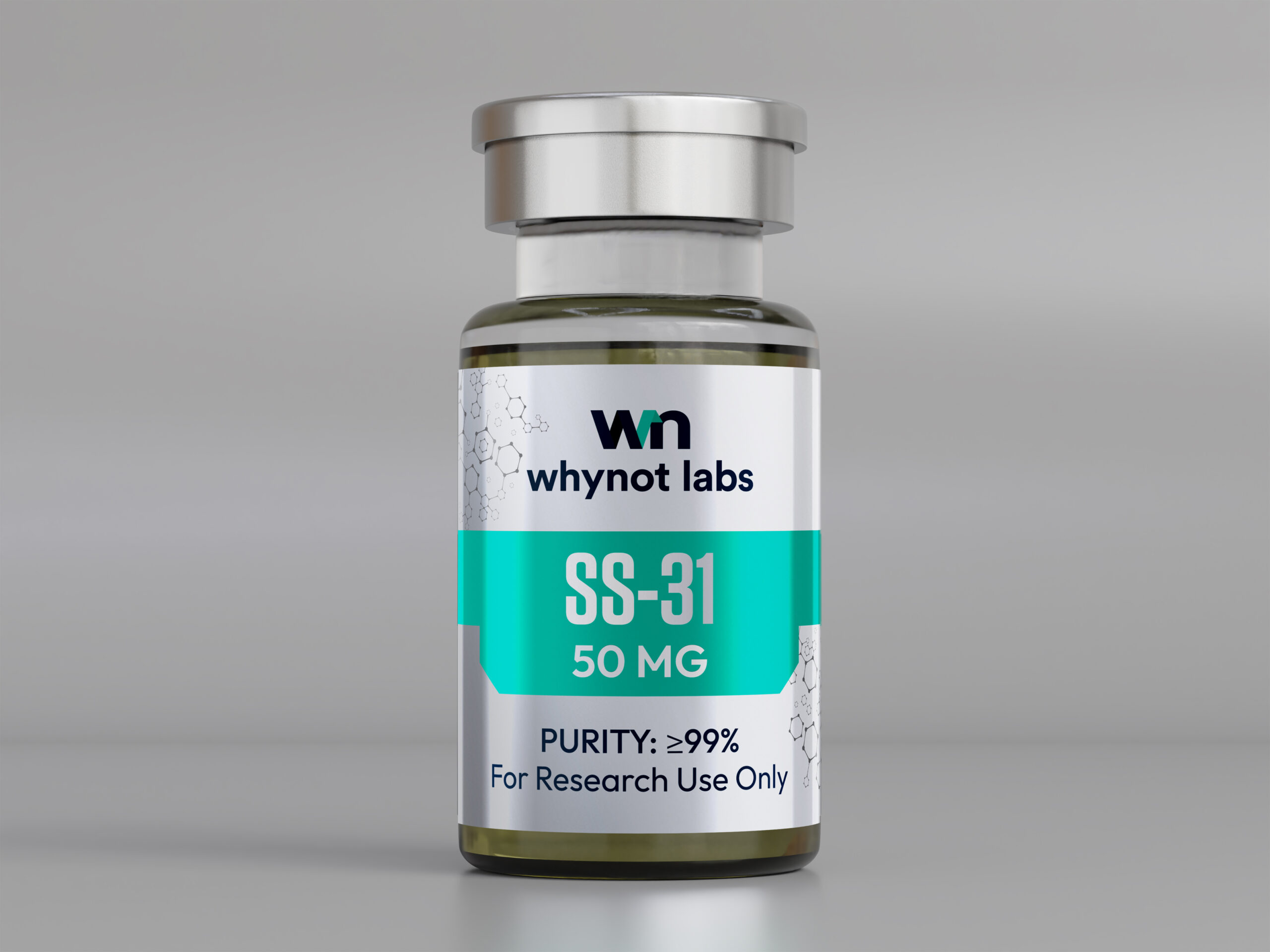
SS-31 (Elamipretide) is a synthetic tetrapeptide with the sequence D-Arg-Dmt-Lys-Phe-NH2, where Dmt is 2′,6′-dimethyltyrosine, a non-natural tyrosine analog. Molecular formula C32H49N5O5, molecular weight 571.77 g/mol, CAS 736992-21-5, PubChem CID 9908089. The compound’s defining research characteristic is its selective accumulation at the inner mitochondrial membrane without requiring a membrane transporter. This behavior is attributed to the alternating aromatic-cationic motif of its sequence and has been characterized in published permeability and subcellular localization studies. Developed by Hazel Szeto and Peter Bhatt at Weill Cornell Medical College as part of the Szeto-Schiller peptide series. Published in vitro research has examined SS-31’s cardiolipin binding at the inner mitochondrial membrane, effects on cytochrome c interactions, electron transport chain function, reactive oxygen species (ROS) generation, and mitochondrial membrane potential in cultured cells. Supplied as lyophilized powder, 50mg per vial, verified by Vanguard Laboratory under a 7-panel conformity protocol (ISO/IEC 17025:2017, A2LA).

For research use only. Not for human consumption.

References:
Szeto HH, AAPS J, 2006 8(2):E277–283
Birk AV et al., J Am Soc Nephrol, 2013 24(8):1250–1261
Szeto HH & Schiller PW, Pharm Res, 2011 28(11):2669–2679

$129.00

Bulk Pricing

1 – 4 Full Price
5 – 9 10% OFF
10+ 15% OFF
Discount automatically applied at checkout
Earn up to 65 points.

Free delivery for orders over $150

Chemical Properties

Chemical Properties

Peptide Class Tetrapeptide — mitochondria-targeted aromatic-cationic peptide
Sequence D-Arg-Dmt-Lys-Phe-NH2 (Dmt = 2',6'-dimethyltyrosine)
Molecular Formula C32H49N5O5
Molecular Weight 571.77 g/mol
Purity ≥98% (Vanguard Laboratory Verified)
Form Lyophilized Powder
Net Content 50mg per vial
Storage -20°C long-term. 2–8°C short-term. Protect from light.

Identifiers

CAS Number 736992-21-5
PubChem CID 9908089
Research Name Elamipretide
Peptide Series Szeto-Schiller (SS) peptide series
Batch ID WNL-2602-J01
Testing Partner Vanguard Laboratory (ISO/IEC 17025:2017, A2LA)

2D Structure — SS-31 (Elamipretide)

SS-31 Elamipretide 2D molecular structure — mitochondria-targeted tetrapeptide CAS 736992-21-5

Description

Overview

SS-31 (Elamipretide) is a synthetic tetrapeptide with the sequence D-Arg-Dmt-Lys-Phe-NH2. Two structural features define it in the research literature. First, it contains D-arginine and 2',6'-dimethyltyrosine (Dmt) — a non-natural amino acid analog not found in standard peptide sequences. Second, and more distinctively, it selectively accumulates at the inner mitochondrial membrane without requiring a transporter protein. Most small peptides do not cross cellular membranes with this degree of specificity. SS-31 does, and the mechanism behind that behavior has been a sustained focus of published research since the early 2000s.

Developed by Hazel Szeto and Peter Bhatt at Weill Cornell Medical College, SS-31 is part of the Szeto-Schiller (SS) peptide series — a family of aromatic-cationic tetrapeptides designed around the hypothesis that alternating aromatic and cationic residues confer mitochondrial membrane permeability. The published research base on SS-31 spans in vitro cell studies, organelle-level assays, and animal model experiments, with a consistent focus on mitochondrial membrane biology.

Biochemical Characteristics

The SS-31 sequence — D-Arg-Dmt-Lys-Phe-NH2 — is notable for three structural decisions. First, the use of D-arginine rather than L-arginine at position 1, which alters the stereochemical presentation at the N-terminus and affects proteolytic susceptibility relative to the all-L-amino acid sequence. Second, Dmt (2',6'-dimethyltyrosine) at position 2, a synthetic tyrosine analog with methyl groups at the 2' and 6' positions of the aromatic ring; this modification has been characterized in published research as contributing to the compound's membrane interaction properties. Third, the C-terminal amide (Phe-NH2) rather than a free carboxyl group, which affects the compound's charge distribution at physiological pH.

Molecular formula C32H49N5O5, molecular weight 571.77 g/mol, CAS 736992-21-5, PubChem CID 9908089. The alternating aromatic (Dmt, Phe) and cationic (D-Arg, Lys) residue pattern is the structural basis for the membrane permeability behavior characterized in published localization studies.

Research Applications

  • Cardiolipin binding studies: characterizing SS-31 interaction with cardiolipin at the inner mitochondrial membrane in cell-free and cell-based assay systems
  • Cytochrome c release assays: examining how SS-31–cardiolipin interaction affects cytochrome c anchoring at the inner membrane
  • Electron transport chain (ETC) function studies: measuring complex I–IV activity in isolated mitochondria and intact cell systems
  • ROS quantification assays: measuring reactive oxygen species generation in cultured cells following SS-31 treatment
  • Mitochondrial membrane potential studies: JC-1 and TMRM assays characterizing membrane potential changes in treated cell lines
  • Subcellular localization studies: fluorescence microscopy and fractionation assays characterizing inner mitochondrial membrane accumulation
  • Cell permeability characterization: membrane permeability assays documenting uptake kinetics of the aromatic-cationic motif across cell types
  • Szeto-Schiller peptide series SAR research: comparative studies across SS peptide variants examining structure-permeability relationships

All applications are restricted to non-clinical laboratory research environments.

Pathway / Mechanistic Context

The primary mechanistic thread in SS-31 research is its cardiolipin interaction. Cardiolipin is a dimeric phospholipid found almost exclusively in the inner mitochondrial membrane; it constitutes approximately 20% of total inner membrane lipid content. Published research by Birk et al. (2013) characterized SS-31's direct binding to cardiolipin using liposome binding assays and documented how this interaction affects the cytochrome c–cardiolipin interaction at the inner membrane surface. Cytochrome c is normally tethered to the inner membrane in part through electrostatic cardiolipin binding; SS-31 competes for that interaction and alters the functional state of cytochrome c in cell-based assay systems.

The electron transport chain effects documented in published research follow from the cytochrome c interaction. SS-31 treatment in cell culture studies has been associated with changes in complex I–IV activity measurements and alterations in ROS generation profiles, which researchers have linked mechanistically to the cardiolipin–cytochrome c axis. Mitochondrial membrane potential measurements using fluorescent dyes (JC-1, TMRM) have also been used to characterize the downstream consequences of SS-31 treatment in cultured cell systems.

The membrane permeability mechanism — the property that allows SS-31 to reach the inner mitochondrial membrane without a transporter — is attributed to the alternating aromatic-cationic sequence architecture. The Szeto-Schiller research group has published on the physicochemical basis of this permeability, proposing that the spatial alternation of hydrophobic aromatic and positively charged residues creates a surface pattern that facilitates spontaneous membrane partitioning and translocation.

Preclinical Research Summary

The foundational published work on SS-31 originates from the Szeto-Schiller research group at Weill Cornell Medical College. Szeto (2006, AAPS Journal) provided an early characterization of the Szeto-Schiller peptide series, describing the rationale for the aromatic-cationic architecture and presenting in vitro localization data documenting inner mitochondrial membrane accumulation. Szeto and Schiller (2011, Pharmaceutical Research) extended this work with a broader review of the peptide series design principles and biological properties documented in cell-based assay systems.

Birk et al. (2013, Journal of the American Society of Nephrology) published the detailed cardiolipin binding characterization, using cardiolipin-containing liposome assays and cultured cell systems to document how SS-31 interacts with the inner mitochondrial membrane lipid environment. This study established the cardiolipin binding model as the mechanistic framework for interpreting SS-31's effects on ETC function and cytochrome c behavior in the cell biology literature.

Form & Analytical Testing

SS-31 (Elamipretide) 50mg is supplied as research-grade lyophilized powder. 50mg is a substantial quantity for in vitro work. Each batch is submitted to Vanguard Laboratory for conformity testing using a 5-vial protocol. The 7-panel protocol covers identity verification (mass spectrometry), purity analysis (≥98% via HPLC), net content verification (50mg confirmed), endotoxin levels, heavy metals screening, sterility, and overall conformity assessment. Batch-specific COAs are published on our COA Library and linked via QR code on each vial.

Referenced Citations

  1. Szeto HH, “Mitochondria-targeted peptide antioxidants: novel neuroprotective agents,” AAPS J, 2006 8(2):E277–283.
  2. Szeto HH & Schiller PW, “Novel therapies targeting inner mitochondrial membrane — from discovery to clinical development,” Pharm Res, 2011 28(11):2669–2679.
  3. Birk AV et al., “The mitochondrial-targeted compound SS-31 re-energizes ischemic mitochondria by interacting with cardiolipin,” J Am Soc Nephrol, 2013 24(8):1250–1261.
  4. Zhao K et al., “Mitochondria-targeted peptide prevents mitochondrial depolarization and apoptosis induced by tert-butyl hydroperoxide in neuronal cell lines,” Biochem Pharmacol, 2004 70(12):1796–1806.

ALL ARTICLES AND PRODUCT INFORMATION PROVIDED ON THIS WEBSITE ARE FOR INFORMATIONAL AND EDUCATIONAL PURPOSES ONLY.

RUO Disclaimer

The products offered on this website are furnished for in-vitro studies only. In-vitro studies (Latin: in glass) are performed outside of the body. These products are not medicines or drugs and have not been approved by the FDA to prevent, treat or cure any medical condition, ailment or disease. Bodily introduction of any kind into humans or animals is strictly forbidden by law. This product should only be handled by licensed, qualified professionals.

This product is not a drug, food, or cosmetic and may not be misbranded, misused, or mislabeled as a drug, food, or cosmetic. No statements on this website have been evaluated by the FDA. You must be 21 years or older to purchase.

COA / HPLC / MS

Batch COA: In Progress

This batch is currently undergoing conformity testing at Vanguard Laboratory. The full Certificate of Analysis — covering identity, purity (≥98% via HPLC), net content (50mg confirmed), endotoxins, heavy metals, and sterility — will be published here and linked via QR code on each vial upon completion.

We don't ship product before results are in. When the COA is live, you'll find it here and on our COA Library.

Notice

Any peptides on our website are sold for research and laboratory use. The products should not be used in form of cosmetic, food additive, chemical, drugs, or other applications not classified in this document. The listing of a material on this site does not constitute a license to its use in infringement of any patent. All customers represented and warranted that through their own review and study that they are fully aware and knowledgeable about the following: Government regulations regarding the use of and exposure to all products. The health and safety hazards associated with the handling of the products they purchase. The necessity of adequately warning of the health and safety hazards associated with any products. The company holds its right to cancel any purchase done if there is any proof or the company sees that you are buying for use other than it is sold for.
“WhyNot Labs” products are intended solely for laboratory research purposes and are not to be used for any other purposes, including but not limited to in vitro diagnostic purpose, in food drugs, medical devices, or cosmetics for humans or animals or for commercial purposes. The purchaser agrees that the products have not been sterilized or tested by “WhyNot Labs” for safety and efficacy in food, drug, medical device, cosmetic, commercial or any other use.

The purchaser expressly represents and warrants to “WhyNot Labs” that the purchaser will properly test, use, manufacture and market any products purchased from “WhyNot Labs” and/or materials produced with products purchased from “WhyNot Labs” in accordance with the practices of a reliable person who is experienced in the field and in strict compliance with all applicable laws and regulations, now and hereinafter enacted.