FOR RESEARCH PURPOSES ONLY-This compound is not FDA approved. All data presented is from clinical trials for educational reference
Mots-C
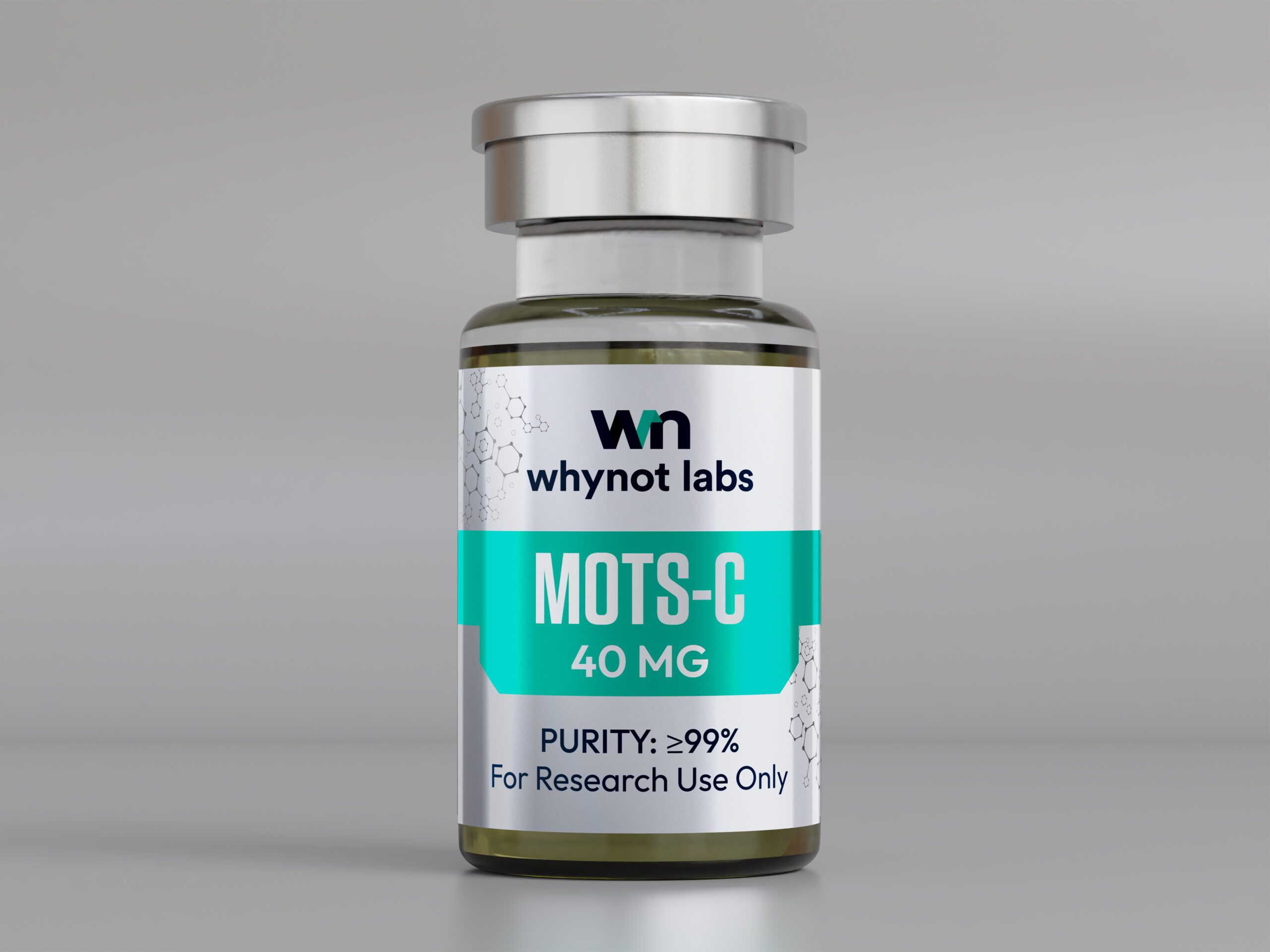
MOTS-c (Mitochondrial Open Reading Frame of the Twelve S rRNA type-c) is a 16-amino acid mitochondrial-derived peptide (MDP) with the sequence MRWQEMGYIFYPRKLR. Molecular formula C₇₈H₁₂₁N₂₁O₂₃S₂, molecular weight 1765.04 g/mol, CAS 1627580-64-6. Unlike nearly all other research peptides, MOTS-c is encoded within mitochondrial DNA — specifically the 12S rRNA gene — rather than the nuclear genome. First described by Lee et al. at the University of Southern California in 2015. Published cell culture studies have examined MOTS-c for activation of the AMPK (AMP-activated protein kinase) signaling pathway, interactions with the folate cycle and AICAR accumulation, and its documented ability to translocate from the mitochondria to the nucleus under stress conditions — an unusual signaling mechanism for a peptide of mitochondrial origin. All published efficacy findings are from in vitro cell-based assays and animal model experiments. Vanguard-tested. 40mg per vial.
For research use only. Not for human consumption.
References:
Lee C et al., Cell Metab, 2015 21(3):443–454
Reynolds JC et al., Nat Commun, 2021 12(1):470
Kim SJ et al., J Physiol, 2017 595(21):6613–6621
$159.00
Bulk Pricing
| 1 – 4 | Full Price |
| 5 – 9 | 10% OFF |
| 10+ | 15% OFF |
Free delivery for orders over $150
Properties
| Molecular Formula | C₇₈H₁₂₁N₂₁O₂₃S₂ |
| Molecular Weight | 1765.04 g/mol |
| Amino Acids | 16 residues |
| Form | Lyophilized Powder |
| Sequence | MRWQEMGYIFYPRKLR |
| Storage | -20°C · Protect from light |
| Purity | ≥98% (Vanguard Verified) |
Identifiers
| CAS Number | 1627580-64-6 |
| Batch ID | WNL-2602-K01 |
| Origin | Mitochondrial-derived (12S rRNA gene) |
Overview
MOTS-c is a 16-amino acid peptide encoded within the mitochondrial genome, specifically the 12S ribosomal RNA gene. Most peptides come from nuclear DNA. MOTS-c doesn't. That makes it a member of a relatively new class called mitochondrial-derived peptides (MDPs), a category that didn't really exist in the literature until Changhan David Lee's group at the University of Southern California described it in 2015.
The mitochondrial origin isn't just a fun fact. It's central to why researchers find this compound interesting. MOTS-c appears to function as a retrograde signal, carrying information from mitochondria back to the nucleus and influencing gene expression in ways that link metabolic state to cellular stress responses. That's an unusual signaling axis for a peptide of this size.
Published research on MOTS-c covers AMPK activation, folate cycle modulation, and nuclear translocation behavior. The research base is newer compared to more established peptides, but it's growing quickly, with publications across metabolomics, aging biology, and exercise physiology.
Biochemical Characteristics
MOTS-c has a 16-residue sequence (MRWQEMGYIFYPRKLR) with a molecular formula of C₇₈H₁₂₁N₂₁O₂₃S₂ and a molecular weight of approximately 1765 g/mol. It's a small peptide by typical standards, compact enough to translocate across membranes, which is part of what makes the nuclear localization data in published studies notable.
The peptide contains methionine and tryptophan residues that contribute to its biochemical behavior. It's classified as an endogenous peptide, meaning it's produced naturally within cells rather than being a synthetic analog of another compound. The sequence is conserved across mammals, which has informed comparative studies in rodent models.
WhyNot Labs' batch WNL-2602-K01 is supplied as lyophilized powder, ≥98% purity, independently verified by Vanguard Laboratory under a 7-panel conformity protocol. Store at -20°C and protect from light.
Research Applications
Published research involving MOTS-c has examined several areas. AMPK pathway activation studies represent the largest body of in vitro work, with cell-based assays exploring how MOTS-c influences downstream signaling in metabolic contexts. The folate cycle and de novo purine biosynthesis pathway, specifically AICAR (5-aminoimidazole-4-carboxamide ribonucleotide) accumulation, has also been examined in published metabolomics work.
Aging biology has been another active area, with several papers examining MOTS-c in the context of mitochondrial peptide signaling and age-related changes in metabolic function. Exercise physiology researchers have looked at endogenous MOTS-c levels in response to physical activity in preclinical models, though this work remains at the investigation stage.
The nuclear translocation research is its own thread. Published cell culture studies have shown MOTS-c localizing to the nucleus under stress conditions and influencing nuclear gene expression. This bidirectional, mitochondria-to-nucleus signaling behavior is not common for peptides of this class, and it's drawn interest from researchers studying the broader MDP field.
Pathway & Mechanistic Context
AMPK (AMP-activated protein kinase) sits at a key node in cellular energy sensing. When energy availability drops and the AMP:ATP ratio rises, AMPK activates and triggers a coordinated response that includes shifts in glucose and fatty acid metabolism, inhibition of anabolic pathways, and autophagy induction. Published research has shown that MOTS-c can activate AMPK in cell culture systems, placing the compound upstream of these downstream effects.
The folate cycle connection is tied to AICAR. MOTS-c has been shown in metabolomics studies to influence the folate cycle, leading to AICAR accumulation. AICAR is itself an AMPK activator, which may represent one mechanism by which MOTS-c influences the pathway, though the full picture is still being characterized in the literature.
The nuclear translocation piece adds another layer. MOTS-c's ability to move from the cytoplasm into the nucleus under cellular stress, and its subsequent influence on nuclear gene transcription patterns, suggests a more direct regulatory role than simple ligand-receptor signaling. Research in this area is ongoing.
Preclinical Research Summary
The foundational 2015 Cell Metabolism paper by Lee et al. identified MOTS-c as a mitochondrial-derived peptide and described its effects on glucose metabolism and insulin sensitivity in cell culture and rodent models. That paper established the AMPK connection and the folate cycle mechanism, and it's been cited extensively in subsequent work.
Subsequent rodent studies have examined MOTS-c in contexts including diet-induced metabolic disruption, aging-associated changes, and physical conditioning. These are animal and cell-culture studies, not human clinical trials, and the findings can't be extrapolated to human outcomes.
Research on the relationship between exercise and circulating MOTS-c levels has appeared in several publications, examining whether physical activity modulates endogenous peptide levels. This work is early-stage and observational in nature. No human therapeutic use has been established or approved.
Form & Analytical Testing
Batch WNL-2602-K01 is supplied as lyophilized (freeze-dried) powder, 40mg per vial, sealed under inert atmosphere. Lyophilization removes water while preserving peptide integrity, extending shelf stability compared to solution form when stored correctly.
Every WhyNot Labs batch goes through 7-panel conformity testing at Vanguard Laboratory (ISO/IEC 17025:2017 accredited, A2LA certified). The protocol covers identity confirmation, purity analysis, net content verification, endotoxin screening, heavy metals testing, sterility testing, and conformity documentation. Five vials per batch are submitted, not a single sample, which is a more rigorous approach than single-vial testing.
The Certificate of Analysis for batch WNL-2602-K01 will be published to the COA Library once testing is complete. Expected turnaround is 17 to 21 days from submission. The COA page is linked via QR code on every vial label.
Referenced Citations
Lee C, et al. MOTS-c: A mitochondrial-derived peptide regulating muscle and fat metabolism. Cell Metab. 2015;21(3):443-454. PMID: 25738459.
Kim SJ, et al. Mitochondrially derived peptides as novel regulators of metabolism. J Physiol. 2017;595(21):6613-6621. PMID: 28762527.
Yin X, et al. The circulating mitochondrial peptide MOTS-c positively correlates with metabolic parameters in elderly subjects. Aging. 2021;13(2):1948-1966. PMID: 33411680.
Reynolds JC, et al. MOTS-c is an exercise-induced mitochondrial-encoded regulator of age-dependent physical decline and muscle homeostasis. Nat Commun. 2021;12(1):470. PMID: 33469022.
Research Use Only
FOR RESEARCH USE ONLY. NOT FOR HUMAN CONSUMPTION.
This product is intended as a research chemical only. All product information available on this website is for educational purposes only. Bodily introduction of any kind into humans or animals is strictly forbidden by law.
No statements on this website have been evaluated by the FDA. This product is not intended to diagnose, treat, cure, or prevent any disease.
You must be 21 years or older to purchase.
<div style="font-family:inherit;padding:4px 0 16px">
<div style="background:rgba(255,255,255,0.02);border:1px solid rgba(255,255,255,0.07);border-radius:8px;padding:32px 28px;text-align:center;max-width:520px;margin:0 auto">
<p style="font-size:28px;margin:0 0 12px">🧪</p>
<p style="font-size:15px;font-weight:700;color:rgba(255,255,255,0.8);margin:0 0 10px">Batch WNL-2602-K01 in Testing</p>
<p style="font-size:14px;color:rgba(255,255,255,0.45);line-height:1.7;margin:0 0 20px">This batch is currently being tested by Vanguard Laboratory under a 7-panel conformity protocol (ISO/IEC 17025:2017, A2LA accredited). The Certificate of Analysis will be published here when testing is complete.</p>
<p style="font-size:13px;color:rgba(255,255,255,0.28);margin:0">Expected: 17–21 days · Questions? [email protected]</p>
</div>
</div>
Related Products
In stock
Bulk Pricing
| 1 – 4 | Full Price |
| 5 – 9 | 10% OFF |
| 10+ | 15% OFF |
In stock
In stock
Bulk Pricing
| 1 – 4 | Full Price |
| 5 – 9 | 10% OFF |
| 10+ | 15% OFF |
In stock
Bulk Pricing
| 1 – 4 | Full Price |
| 5 – 9 | 10% OFF |
| 10+ | 15% OFF |
In stock
Bulk Pricing
| 1 – 4 | Full Price |
| 5 – 9 | 10% OFF |
| 10+ | 15% OFF |
In stock
In stock
Bulk Pricing
| 1 – 4 | Full Price |
| 5 – 9 | 10% OFF |
| 10+ | 15% OFF |
In stock
In stock
In stock
Bulk Pricing
| 1 – 4 | Full Price |
| 5 – 9 | 10% OFF |
| 10+ | 15% OFF |
In stock
In stock
Notice
Any peptides on our website are sold for research and laboratory use. The products should not be used in form of cosmetic, food additive, chemical, drugs, or other applications not classified in this document. The listing of a material on this site does not constitute a license to its use in infringement of any patent. All customers represented and warranted that through their own review and study that they are fully aware and knowledgeable about the following: Government regulations regarding the use of and exposure to all products. The health and safety hazards associated with the handling of the products they purchase. The necessity of adequately warning of the health and safety hazards associated with any products. The company holds its right to cancel any purchase done if there is any proof or the company sees that you are buying for use other than it is sold for.
“WhyNot Labs” products are intended solely for laboratory research purposes and are not to be used for any other purposes, including but not limited to in vitro diagnostic purpose, in food drugs, medical devices, or cosmetics for humans or animals or for commercial purposes. The purchaser agrees that the products have not been sterilized or tested by “WhyNot Labs” for safety and efficacy in food, drug, medical device, cosmetic, commercial or any other use.
The purchaser expressly represents and warrants to “WhyNot Labs” that the purchaser will properly test, use, manufacture and market any products purchased from “WhyNot Labs” and/or materials produced with products purchased from “WhyNot Labs” in accordance with the practices of a reliable person who is experienced in the field and in strict compliance with all applicable laws and regulations, now and hereinafter enacted.