Research Hub
Peptide Purity Explained: What 98% vs 99% Actually Means for Your Research
How HPLC testing works, what those purity percentages really measure, and why a claim without a COA is just a number someone typed.
For Research Use Only
Last Updated: March 2026
⚠️ FOR RESEARCH USE ONLY. All products referenced on this page are sold strictly for in vitro laboratory research. Not for human or animal consumption. Statements have not been evaluated by the FDA.
What is peptide purity? Peptide purity refers to the percentage of a sample that contains the target peptide sequence, measured by High-Performance Liquid Chromatography (HPLC) peak area analysis. A 98% purity rating means 98% of the sample's detected peaks correspond to the intended compound, with the remaining 2% consisting of related peptide impurities, truncated sequences, or residual salts. Purity verification through independent third-party Certificates of Analysis is considered the standard for research-grade quality assurance.
Quick Reference
Purity at a Glance
| Term |
What It Means |
| HPLC Purity | Percentage of target peptide in a sample, measured by chromatographic peak area |
| 98% Purity | Research-grade standard; suitable for most in vitro laboratory applications |
| 99%+ Purity | High-purity grade; preferred for sensitive assays requiring minimal interference |
| Related Peptides | Structurally similar byproducts from synthesis (deletions, truncations, insertions) |
| COA | Third-party lab document verifying identity, purity, and quantity of a compound |
| HPLC | High-Performance Liquid Chromatography — the gold-standard method for purity testing |
| Lyophilized | Freeze-dried powder form — the standard presentation for research peptides |
| WhyNot Labs Standard | ≥98% purity verified by Vanguard Laboratory on every batch |
The Basics
What Does "Purity" Actually Measure in Research Peptides?
The word "purity" gets thrown around in the research peptide space like confetti. Every company claims high purity. Very few can prove it.
So what does it actually measure?
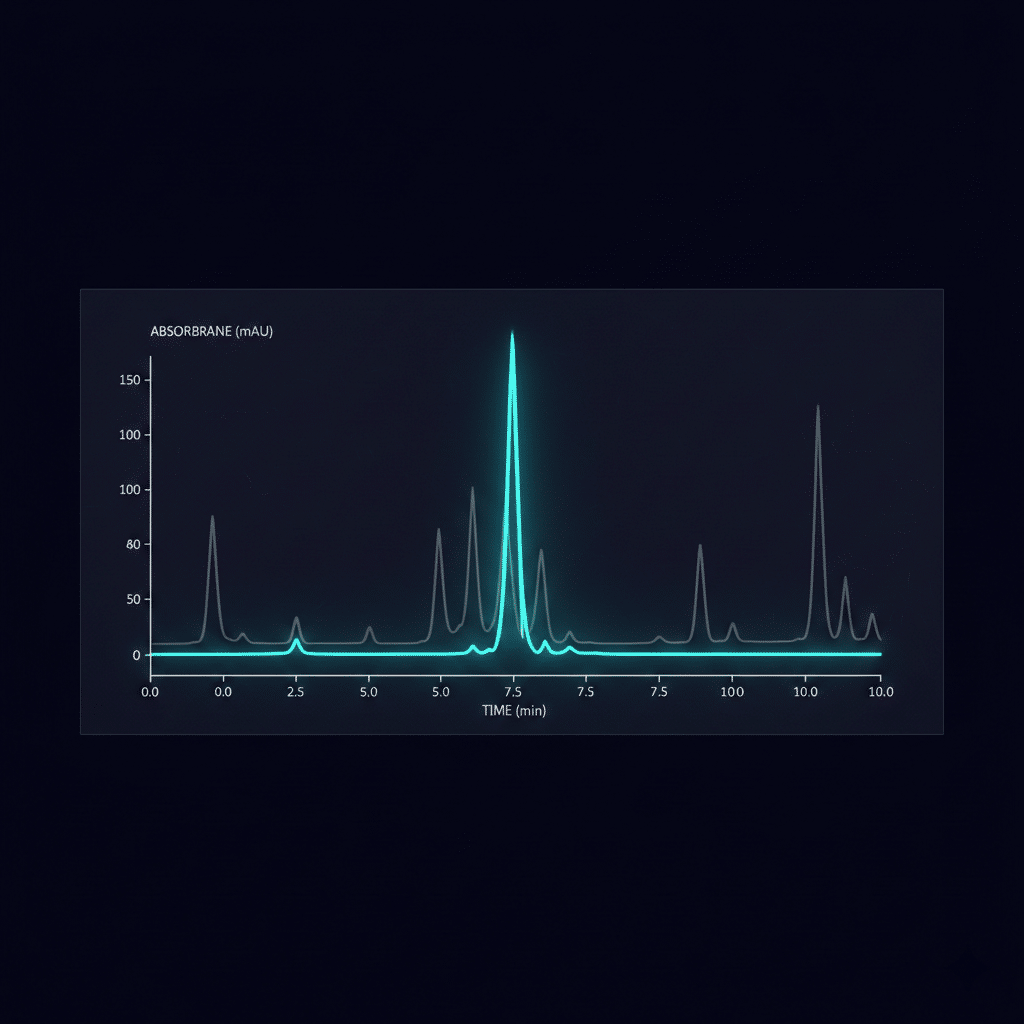
Purity represents the proportion of a sample that contains the correct, target peptide sequence. It's measured using HPLC (High-Performance Liquid Chromatography), which separates a sample's components based on their chemical properties and produces a chromatogram showing distinct peaks. The main peak represents your target compound. The smaller peaks? Those are everything else.
Purity is expressed as a percentage of total peak area. When you see "98% purity," that means 98% of the detected material in that sample is the peptide you ordered. The other 2% is a mix of synthesis byproducts — and we'll get into exactly what those are below.
Simple concept. But the devil's in the details.
All purity discussions reference laboratory analysis of research compounds. For research use only.
Testing Methodology
How HPLC Purity Testing Actually Works
HPLC has been the workhorse of analytical chemistry since the 1970s and is the accepted standard for peptide purity analysis across academic and commercial research. The basic principle: dissolve a small sample, push it through a packed column at high pressure, and different molecules separate based on how they interact with the column material.
A detector at the end records each compound as it exits. Different compounds exit at different times (called retention times), producing peaks on a chromatogram. Think of it like a race — every molecule in your sample runs through the column at its own speed. The target peptide crosses the finish line at a predictable time. Impurities cross at different times.
The detector measures each peak's area. Your purity percentage comes from dividing the target peptide's peak area by the total peak area of all detected compounds. No magic. Just math.
Important: Not all HPLC methods are equal. Column type, solvent system, gradient program, and detection wavelength all affect results. A company could run conditions that make their product look cleaner than it is. Published analytical chemistry literature (Journal of Chromatography A, 2021) confirms that method variability between laboratories can account for 1-2% differences in reported purity values for the same sample. This is exactly why independent, third-party testing matters more than in-house claims.
Purity analysis described here refers to standard laboratory quality control procedures. For research use only.
Purity Grades Compared
98% vs 99% vs 99.5%: When the Difference Actually Matters
Is the difference between 98% and 99% purity going to affect your research? In most cases, no. But there are situations where it matters.
≥98%
General In Vitro Research
The accepted benchmark for standard laboratory assays. Most published preclinical studies use compounds at this grade or equivalent. The 2% impurity content is unlikely to interfere with typical receptor binding studies, cell culture experiments, or stability testing protocols.
≥99%
Sensitive Quantitative Assays
Where that extra 1-2% starts to matter. Dose-response curves in cell-based models where precision is critical, or studies where impurities could act as confounding variables at the receptor level. Cleaner data. Less noise.
≥99.5%
Niche Specialized Applications
Reference standard preparation, method validation studies, or highly sensitive bioassays. For the vast majority of laboratory work, this is overkill — and you'll pay for it accordingly.
The honest answer: 98% verified by an independent lab beats an unverified claim of 99.9% every single day. Proof matters more than promises.
Purity grade recommendations apply to in vitro research contexts only. For research use only.
Impurity Profile
What's in the Other 1-2%? Understanding Peptide Impurities
Your sample is 98% pure. What's the other 2%? Most suppliers won't tell you — but it's not a mystery if you understand peptide synthesis.
Research peptides are manufactured using solid-phase peptide synthesis (SPPS), where amino acids are added one at a time to a growing chain anchored to a resin bead. Each coupling step isn't 100% efficient. Across a 30 or 40-amino-acid sequence, small errors accumulate.
Deletion Peptides
Missing one or more amino acids from the sequence. If coupling efficiency at a given position was slightly below optimal, a fraction of chains skipped that amino acid entirely. Structurally similar to the target but functionally different.
Truncated Sequences
Shorter fragments where synthesis terminated prematurely. The chain stopped growing at some point and got cleaved off the resin along with everything else.
Oxidized Forms
Amino acids like methionine, cysteine, and tryptophan are prone to oxidation during synthesis, cleavage, or storage. An oxidized version of the target peptide shows up as a separate peak on HPLC.
Residual Salts and Solvents
TFA (trifluoroacetic acid) from the cleavage step, acetonitrile from purification, or counterions used in salt exchange. These don't always appear on HPLC but affect overall composition.
Key point most researchers miss: not all 2% impurities are equal. A sample that's 98% pure with 2% deletion peptides is very different from a sample that's 98% pure with 2% residual TFA. The first has structurally related compounds that might have partial biological activity in research models. The second has a solvent residue that's largely inert at trace levels. A good COA tells you which you're dealing with.
Impurity profiles are relevant to research compound quality assessment. For research use only.
Industry Transparency
Why Purity Claims Without a COA Are Worthless
A company claiming 99% purity without a third-party COA is like claiming you ran a 4-minute mile without a stopwatch. Cool story. Prove it.
It's easy to write "99% purity" in a product description. Actually verifying that claim with an independent laboratory costs real money — roughly $200-400 per compound per batch. And that's per batch, not a one-time thing. So what should a legitimate COA include?
✓
Identity verification
The lab confirms the compound is what it claims to be, usually through mass spectrometry (MS) matching the expected molecular weight. Results should match within acceptable instrument tolerance.
✓
Purity analysis
HPLC chromatogram with the main peak identified and purity calculated from peak area percentages. You should see the actual chromatogram, not just a number.
✓
Quantity verification
A vial labeled 30mg at 98% purity but containing only 22mg of actual content is a different product than advertised. Net peptide content analysis confirms you're getting what you paid for.
✓
Batch-specific data
The COA should reference a specific batch or lot number that matches your product. A "generic" COA that doesn't tie to a particular production run is a red flag the size of Texas.
And the most important factor: the lab should be independent. Not the manufacturer's in-house lab. Not the supplier's partner who runs tests on the side. When the lab has no financial interest in whether your product passes or fails, that's when you get honest results.
COA standards discussed here apply to research compound quality verification. For research use only.
Beyond HPLC
HPLC Isn't the Only Test That Matters
HPLC gets all the attention because purity is the headline number. But a complete quality picture requires more than one test. HPLC tells you how pure your sample is — it doesn't tell you the whole story.
| Test |
What It Reveals |
| HPLC | Purity — percentage of target compound vs. impurities |
| Mass Spectrometry (MS) | Identity — confirms molecular weight matches expected value |
| Endotoxin Testing | Bacterial contamination — lipopolysaccharides that can confound cell-based models |
| Sterility Testing | Absence of viable microorganisms — relevant for cell culture research |
| Appearance & Solubility | Visual confirmation — lyophilized peptides should be white to off-white powder, not yellow or clumpy |
Not every application needs every test. But purity alone — without identity confirmation at minimum — leaves a gap in your quality assurance.
Testing standards described here are for research compound quality control. For research use only.
COA Evaluation
How to Read a Peptide COA (Without a Chemistry Degree)
You don't need to be an analytical chemist to evaluate a COA. You just need to know what to look for.
1
Check the lab name
Is it an independent third party? If the COA just lists the company's own name, that's the equivalent of grading your own homework. Look for a recognized independent laboratory.
2
Match the batch number
The COA should reference a batch or lot number that matches your product label. A COA that doesn't tie to your specific production run is irrelevant to your vial.
3
Find the HPLC purity
Should be stated clearly as a percentage. Look for the actual chromatogram if provided. A single dominant peak is what you want to see.
4
Verify identity
Mass spec results should show a molecular weight matching the expected value. Most COAs will state "confirmed" or provide observed vs. expected molecular weight.
5
Check the date
COAs from three years ago don't tell you much about a batch produced last month. Testing should be recent and relevant to the specific batch you're purchasing.
If a supplier can't provide a COA when you ask? That tells you everything you need to know.
Read our full COA guide for a complete walkthrough →
COA evaluation guidelines apply to research procurement decisions. For research use only.
From WhyNot Labs
We could claim 99.9% on every product page. Nobody's stopping us. But we'd rather show you the actual numbers. Every batch is independently tested by Vanguard Laboratory before it ships — not selected batches, not random spot-checks. Every single one. Full COAs published in our COA Library, linked to your specific batch number.
We set the floor at ≥98%. We'd rather under-promise and over-deliver than play the same purity inflation game everyone else is running.
WhyNot Labs sells research compounds only. Not for human consumption.
FAQ
Frequently Asked Questions About Peptide Purity
What does 98% purity mean for a research peptide?
A 98% purity rating means that 98% of the sample's HPLC-detected peak area corresponds to the target peptide compound. The remaining 2% consists of synthesis-related impurities such as deletion peptides, truncated sequences, oxidized forms, or residual salts from the manufacturing process.
Is 99% purity significantly better than 98%?
For most standard in vitro research applications, the functional difference is minimal. The distinction becomes more relevant in sensitive quantitative assays, dose-response studies, or experiments where trace impurities could act as confounding variables. The more important factor is whether the purity claim is independently verified.
How is peptide purity measured?
Peptide purity is measured using High-Performance Liquid Chromatography (HPLC), which separates a dissolved sample's components through a packed column under high pressure. A detector records each component as a peak on a chromatogram, and purity is calculated by dividing the target peptide's peak area by the total detected peak area.
What should I look for on a Certificate of Analysis?
A credible COA should include: the name of an independent testing laboratory, a batch-specific lot number, HPLC purity percentage (ideally with the chromatogram), mass spectrometry identity confirmation, net peptide content or quantity verification, and a recent testing date.
Why does independent third-party testing matter?
Independent testing removes the financial conflict of interest inherent in self-reporting. When the testing laboratory has no relationship with the manufacturer or seller, the results reflect actual sample quality rather than marketing goals. In-house testing is essentially self-grading, which is why third-party verification from an independent analytical laboratory is considered the reliable standard.
Can peptide purity degrade over time?
Yes. Peptides can degrade through oxidation, hydrolysis, or aggregation, particularly when exposed to heat, moisture, light, or repeated freeze-thaw cycles. Proper storage (typically at -20°C for lyophilized powders, protected from light and moisture) helps maintain the purity established at the time of testing.
What's the difference between "pharmaceutical grade" and "research grade" purity?
"Pharmaceutical grade" implies compliance with specific regulatory frameworks (USP or EP standards) that include manufacturing controls, contamination limits, and documentation requirements beyond HPLC purity. "Research grade" refers to compounds produced and tested for laboratory research purposes. WhyNot Labs doesn't use the term "pharmaceutical grade" because our products are research compounds, not regulated drugs. We test to ≥98% HPLC purity via independent third-party analysis — which is the honest way to communicate quality.
Research Use Disclaimer
All products sold by WhyNot Labs are intended for laboratory research use only. Not for human or animal consumption. These products are not drugs, foods, or cosmetics and have not been evaluated by the FDA. Products are not intended to diagnose, treat, cure, or prevent any disease. By purchasing, you confirm you are a qualified researcher over 21 years of age.
Written by Ash, Founder of WhyNot Labs. All WhyNot Labs products are independently tested by Vanguard Laboratory with full Certificates of Analysis published for every batch.